Pure Pursuit Lane Following with Obstacle Avoidance
Project Resources
Objective: Develop a lane following and obstacle avoidance system using the pure pursuit control for Duckiebots. (DB18)
Approach: Use an adaptive pure pursuit controller with dynamic speed tuning, integrated with vision-based deep-learning based object detection for obstacle-aware navigation.
Authors: Soroush Saryazdi, Dhaivat Bhatt, Robotics and Embodied AI Lab (REAL), Université de Montréal and is also affiliated with MILA.
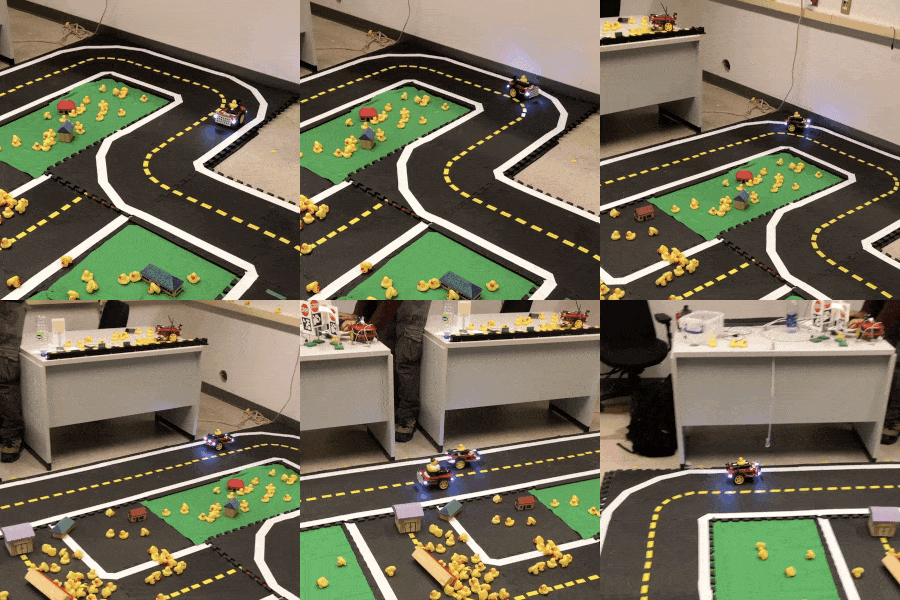
Pure Pursuit Controller with Dynamic Speed and Turn Handling
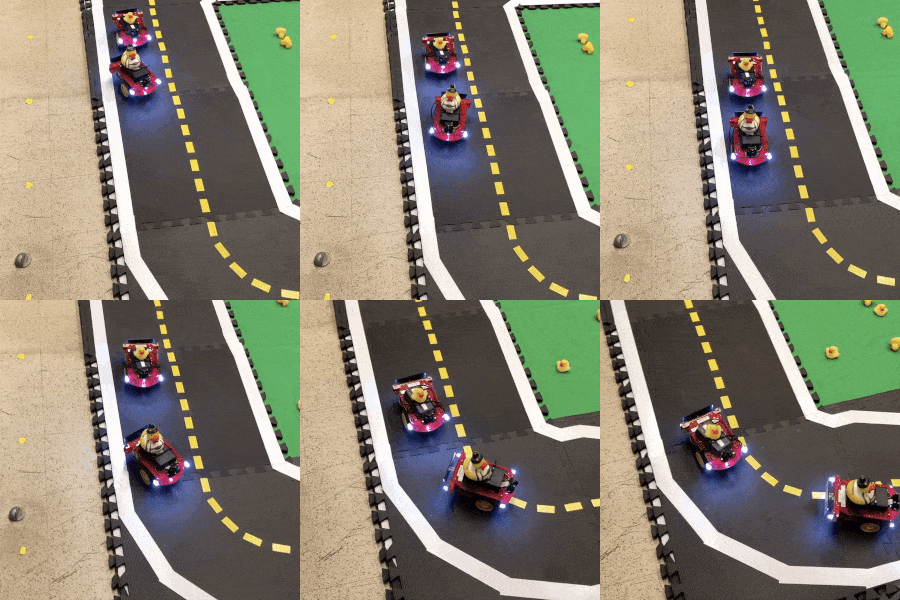
Pure Pursuit with Image Processing-Based Obstacle Detection
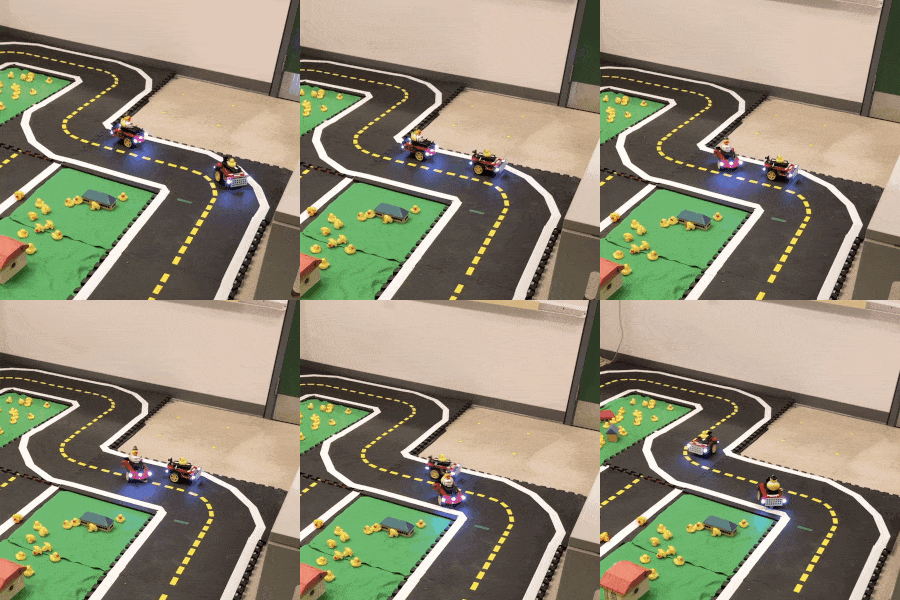
Duckiebots Avoiding Obstacles with Pure Pursuit Control
Pure Pursuit Lane Following with Obstacle Avoidance - the objectives
Pure pursuit is a geometric path tracking algorithm used in autonomous vehicle control systems. It calculates the curvature of the road ahead by determining a target point on the trajectory and computing the required angular velocity to reach that point based on the vehicle’s kinematics.
Unlike proportional integral derivative (PID) control, which adjusts control outputs based on continuous error correction, pure pursuit uses a lookahead point to guide the vehicle along a trajectory, enabling stable convergence to the path without oscillations. This method avoids direct dependency on derivative or integral feedback, reducing complexity in environments with sparse or noisy error signals.
This project aims to implement a pure pursuit-based lane following system integrated with obstacle avoidance for autonomous Duckiebot navigation. The goal is to enable real-time tracking of lane centerlines while maintaining safety through detection and response to dynamic obstacles such as other Duckiebots or cones.
The pipeline includes a modified ground projection system, an adaptive pure pursuit controller for path tracking, and both image processing and deep learning-based object detection modules for obstacle recognition and avoidance.
Faster RCNN Architecture with Feature Pyramid Network
Faster RCNN Detection Output with Bounding Boxes
Detection Results for Obstacle Avoidance in Duckietown
The primary challenges in this project include robust target point estimation under variable lighting and environmental conditions, real-time object detection with limited computational resources, and smooth trajectory control in the presence of dynamic obstacles.
The approach involves modular integration of perception, planning, and control subsystems.
For perception, the system uses both classical image processing methods and a trained deep learning model for object detection, enabling redundancy and simulation compatibility.
For planning and control, the pure pursuit controller dynamically adjusts speed and steering based on the estimated target point and obstacle proximity. Target point estimation is achieved through ground projection, a transformation that maps image coordinates to real-world planar coordinates using a calibrated camera model. Real-time parameter tuning and feedback mechanisms are included to handle variations in frame rate and sensor noise.
Obstacle positions are also ground-projected and used to trigger stop conditions within a defined safety zone, ensuring collision avoidance through reactive control.
Looking for similar projects?
Check out the following works on path planning with Duckietown:
Dhaivat Bhatt is currently working as a Machine learning research engineer at Samsung AI centre, Toronto.
Learn more
Duckietown is a modular, customizable, and state-of-the-art platform for creating and disseminating robotics and AI learning experiences.
Duckietown is designed to teach, learn, and do research: from exploring the fundamentals of computer science and automation to pushing the boundaries of knowledge.
These spotlight projects are shared to exemplify Duckietown’s value for hands-on learning in robotics and AI, enabling students to apply theoretical concepts to practical challenges in autonomous robotics, boosting competence and job prospects.
Deep Reinforcement Learning for Autonomous Lane Following
Project Resources
Objective: Develop a deep reinforcement learning model for autonomous lane following with sim-to-real transfer.
Approach: Train a reinforcement learning agent in simulation using an autoencoder-based feature extraction pipeline and deploy it on a real Duckiebot with domain adaptation techniques.
Authors: Mickyas Tamiru Asfaw, David Bertoin, Valentin Guillet
Here is a visual tour of the author’s work on implementing deep reinforcement learning for autonomous lane following in Duckietown.
Figure 1. Deep Reinforcement Learning Architecture for Lane Following.
Figure 2. Autoencoder Architecture for Deep Reinforcement Learning.
Figure 3. Image Preprocessing and Autoencoder Reconstruction.
Deep reinforcement learning for autonomous lane following in Duckietown: objective and importance
Would it not be great if we could train an end-to-end neural network in simulation, plug it in the physical robot and have it drive safely on the road?
Inspired by this idea, Mickyas worked to implement deep reinforcement learning (DRL) for autonomous lane following in Duckietown, training the agent using sim-to-real transfer.
The project focuses on training DRL agents, including Deep Deterministic Policy Gradient (DDPG), Twin Delayed DDPG (TD3), and Soft Actor-Critic (SAC), to learn steering control using high-dimensional camera inputs. It integrates an autoencoder to compress image observations into a latent space, improving computational efficiency.
The hope is for the trained DRL model to generalize from simulation to real-world deployment on a Duckiebot. This involves addressing domain adaptation, camera input variations, and real-time inference constraints, amongst other implementation challenges.
Autonomous lane following is a fundamental component of self-driving systems, requiring continuous adaptation to environmental changes, especially whn using vision as main sensing modality. This project identifies limitations in existing DRL algorithms when applied to real-world robotics, and explores modifications in reward functions, policy updates, and feature extraction methods analyzing the results through real world experimentation.
The method and challenges in implementing deep reinforcement learning in Duckietown
The method involves training a DRL agent in a simulated Duckietown environment (Gym Duckietown Simulator) using an autoencoder for feature extraction.
The encoder compresses image data into a latent space, reducing input dimensions for policy learning. The agent receives sequential encoded frames as observations and optimizes steering actions based on reward-driven updates. The trained model is then transferred to a real Duckiebot using a ROS-based communication framework.
Challenges for pulling this off include accounting for discrepancies between simulated and real-world camera inputs, which affect performance and generalization. Differences in lighting, surface textures, and image normalization require domain adaptation techniques.
Moreover, computational limitations on the Duckiebot prevent direct onboard execution, requiring a distributed processing setup.
Reward shaping influences learning stability, and improper design of the reward function leads to policy exploitation or suboptimal behavior. Debugging DRL models is complex due to interdependencies between network architecture, exploration strategies, and training dynamics.
The project addresses these challenges by refining preprocessing, incorporating domain randomization, and modifying policy structures.
Deep reinforcement learning for autonomous lane following: full report
Deep reinforcement learning for autonomous lane following in Duckietown: Authors
Duckietown is a modular, customizable, and state-of-the-art platform for creating and disseminating robotics and AI learning experiences.
Duckietown is designed to teach, learn, and do research: from exploring the fundamentals of computer science and automation to pushing the boundaries of knowledge.
These spotlight projects are shared to exemplify Duckietown’s value for hands-on learning in robotics and AI, enabling students to apply theoretical concepts to practical challenges in autonomous robotics, boosting competence and job prospects.

Reinforcement Learning for the Control of Autonomous Robots
Project Resources
Objective: Develop and evaluate reinforcement learning (RL) techniques for safe and autonomous navigation in any Duckietown
Approach: Develop, train and test RL algorithms including Deep Q-Networks (DQN), Deep Deterministic Policy Gradient (DDPG), and Proximal Policy Optimization (PPO), for autonomous lane-keeping and obstacle detection on a DB21 Duckiebot.
Here is a visual tour of the authors’ work on implementing reinforcement learning in Duckietown.
Figure 1. Principle of Reinforcement Learning in Autonomous Driving.
Figure 2. Reinforcement Learning in the Duckietown Environment.
Figure 3. Q-learning vs. Deep Q-Networks (DQN).
Figure 4. Learning Process with the Deep Q-Network (DQN) Model.
Figure 5. Architecture of the Deep Deterministic Policy Gradient (DDPG) Algorithm.
Figure 6. Simulation Environment in Duckietown.
Figure 7. Modular Test Track for Duckiebot Driving Tests.
Figure 8. Reward Factors for DQN in Duckiebot Navigation.
Figure 9. Line Detection Improvement with HSV Parameter Correction.
Figure 10. DQN Model Structure.
Figure 11. Training Map for DQN.
Figure 12. Differences Between Simulation and Reality.
Figure 13. DQN (PA2): Average Reward and Average Episode Length.
Figure 14. DDPG Training 1: Episode-Based Rewards.
Figure 15. DDPG Training 2: Episode-Based Rewards.
Figure 16. Average Rewards During Training.
Figure 17. Average Distance Traveled During Episodes.
Figure 18. Evolution of the Agent's Speed.
Figure 19. Trial 1: Average Reward and Average Episode Length.
Figure 20. Trial 2: Average Reward and Average Episode Length.
Figure 21. Trial 3: Average Reward and Average Episode Length.
Figure 22. Trial 4: Average Reward and Average Episode Length.
Figure 23. Agent Trajectory on the Evaluation Track.
Figure 24. Trial 5: Average Reward and Average Episode Length.
Figure 25. Trial 6: Average Reward and Average Episode Length.
Figure 26. Trajectory Taken by the Robot to Negotiate a Bend.
Figure 27. Evolution of the Safety Factor.
Why reinforcement learning for the control of Duckiebots in Duckietown?
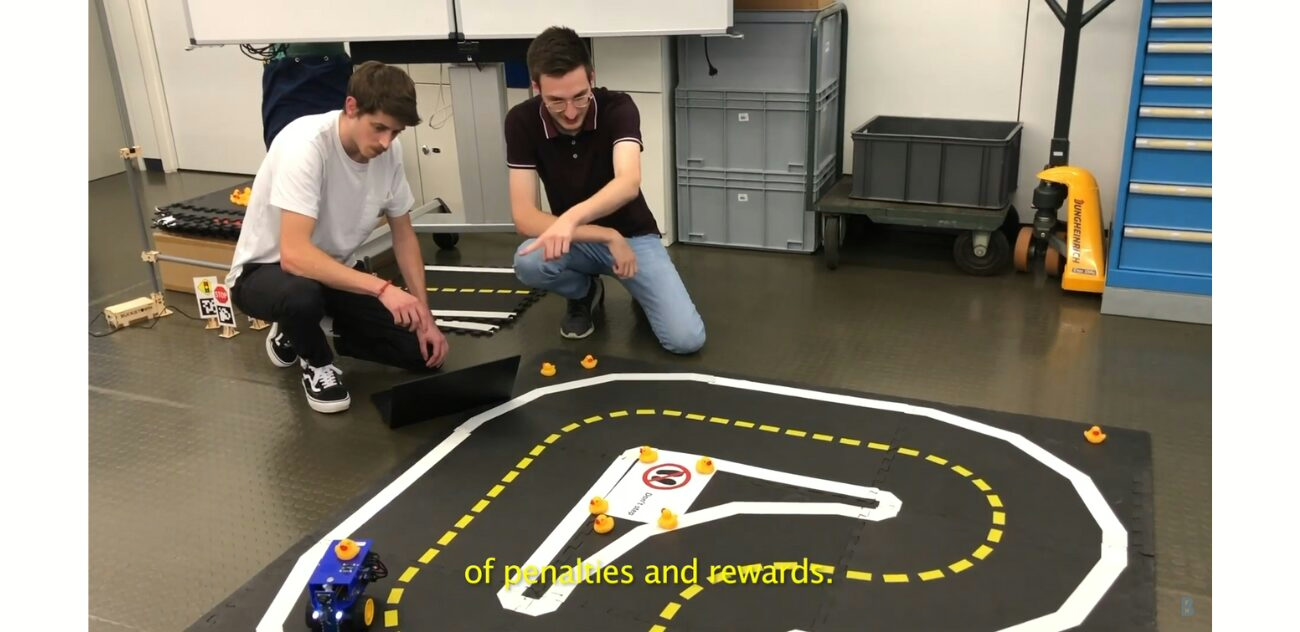
This thesis explores the use of reinforcement learning (RL) techniques to enable autonomous navigation in the Duckietown. Reinforcement learning is a type of machine learning where an agent learns to make decisions by performing actions in an environment and receiving feedback through rewards or penalties. The goal is to maximize long-term rewards.
This work focuses on implementing and comparing various RL algorithms—specifically Deep Q-Network (DQN), Deep Deterministic Policy Gradient (DDPG), and Proximal Policy Optimization (PPO) – to analyze performance in autonomous navigation. RL enables agents to learn behaviors by interacting with their environment and adapting to dynamic conditions. The PPO model was found demonstrating smooth driving using grayscale images for enhanced computational efficiency.
Another feature of this project is the integration of YOLO v5, an object detection model, which allowed the Duckiebot to recognize and stop for obstacles, improving its safety capabilities. This integration of perception and RL enabled the Duckiebot not only to follow lanes but also to navigate autonomously, making ‘real-time’ adjustments based on its surroundings.
By transferring trained models from simulation to physical Duckiebots (Sim2Real), the thesis evaluates the feasibility of applying these models to real-world autonomous driving scenarios. This work showcases how reinforcement learning and object detection can be combined to advance the development of safe, autonomous navigation systems, providing insights that could eventually be adapted for full-scale vehicles.
Reinforcement learning for the control of Duckiebots in Duckietown - the challenges
Implementing reinforcement learning, in this project faced a number of challeneges summarized below –
Transfer from Simulation to Reality (Sim2Real): Models trained in simulations often encountered difficulties when applied to real-world Duckiebots, requiring adjustments for accurate and stable performance.
Computational Constraints: Limited processing power on the Duckiebots made it challenging to run complex RL models and object detection algorithms simultaneously.
Stability and Safety of Learning Models: Guaranteeing that the Duckiebot’s actions were safe and did not lead to erratic behaviors or collisions required fine-tuning and extensive testing of the RL algorithms.
Obstacle Detection and Avoidance: Integrating YOLO v5 for obstacle detection posed challenges in ensuring smooth integration with RL, as both systems needed to work harmoniously for obstacle avoidance.
These challenges were addressed through algorithm optimization, iterative model testing, and adjustments to the hyperparameters.
Reinforcement learning for the control of Duckiebots in Duckietown: Results
Reinforcement learning for the control of Duckiebots in Duckietown: Authors
Duckietown is a modular, customizable and state-of-the-art platform for creating and disseminating robotics and AI learning experiences.
It is designed to teach, learn, and do research: from exploring the fundamentals of computer science and automation to pushing the boundaries of knowledge.
Safe Reinforcement Learning (Safe-RL) in Duckietown
Project Resources
Objective: Implement safe reinforcement learning (Safe-RL) to train Duckiebots at follow a lane, while keeping the robots within the boundaries of the road.
Approach: Deep Q Learning
Authors: Jan Steinmüller, Dr. Amr Alanwar Abdelhafez
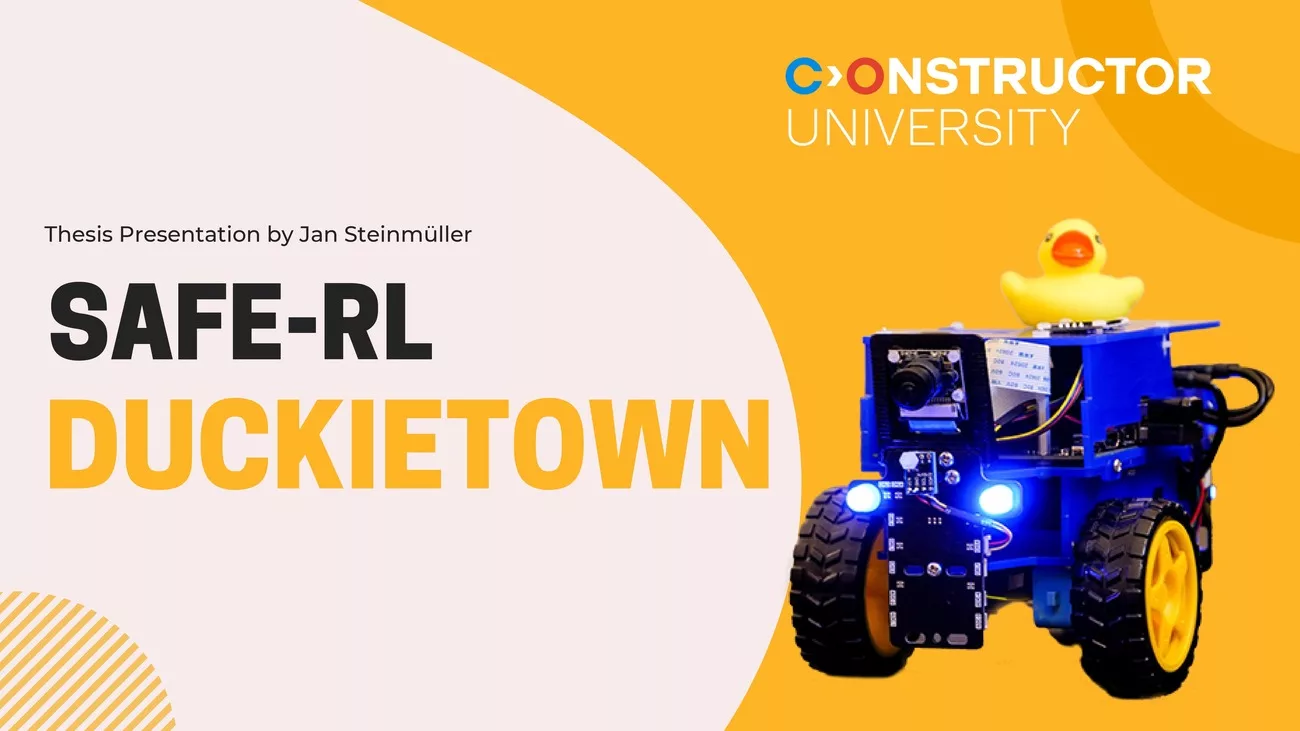
Safe-RL Duckietown Project – In his thesis titled “Safe-RL-Duckietown“, Jan Steinmüller used safe reinforcement learning to train Duckiebots to follow a lane while keeping said robots safe during training.
Safe Reinforcement Learning involves learning policies that maximize expected returns while ensuring reasonable system performance and adhering to safety constraints throughout both the learning and deployment phases. Reinforcement learning is a machine learning paradigm where agents learn to make decisions by maximizing cumulative rewards through interaction with an environment, without the necessity for training data or models.
The final result was a trained agent capable of following lanes while avoiding unsafe positions.
This is an open source project, and can be reproduced and improved upon through the Duckietown platform.
Process diagram of action selection and safety layer
Results of the Safe-RL Duckietown Project
Safe Reinforcement Learning: Results and Conclusions
Based on the results, it can be concluded that there is no disadvantage to using a safety layer when doing reinforcement learning since execution time is very similar. Moreover, the dramatically improved safety of the vehicle is helpful for the robot’s training as fewer actions with lower or even negative rewards will be executed. Because of this, reinforcement learning agents with safety layers learn faster and reduce the number of unsafe actions that are being executed.
Unfortunately, manual observation and intervention by the user were still necessary, however, the frequency was clearly reduced which further improved learning as the robots in testing did not know if an outside intervention was done which could result in an action being rewarded incorrectly.
It was also concluded that this project did not reach perfect safety with the implementation. Therefore a fully autonomous reinforcement learning training without any human intervention has not yet been achieved. A lot of improvement factors have been found that can further improve the safety and recovery rate. Additionally, some major problems which are not direct results of the reinforcement learning or safety layer have been identified.
These problems could be attempted to be fixed in different ways like improving the open source implementations of lane filter nodes or adding more sensors or cameras to the robot in order to extend the input data to the agent. Another area that was untouched during the research of this project was other vehicles inside the current lane. The safety layer could potentially be extended to also include safety features that should keep the robot safe from hitting other vehicles.
Jan Steinmüller is a computer science student working in the computer networks and information security research group at Hochschule Bremen in Germany.
Duckietown is a modular, customizable and state-of-the-art platform for creating and disseminating robotics and AI learning experiences.
It is designed to teach, learn, and do research: from exploring the fundamentals of computer science and automation to pushing the boundaries of knowledge.