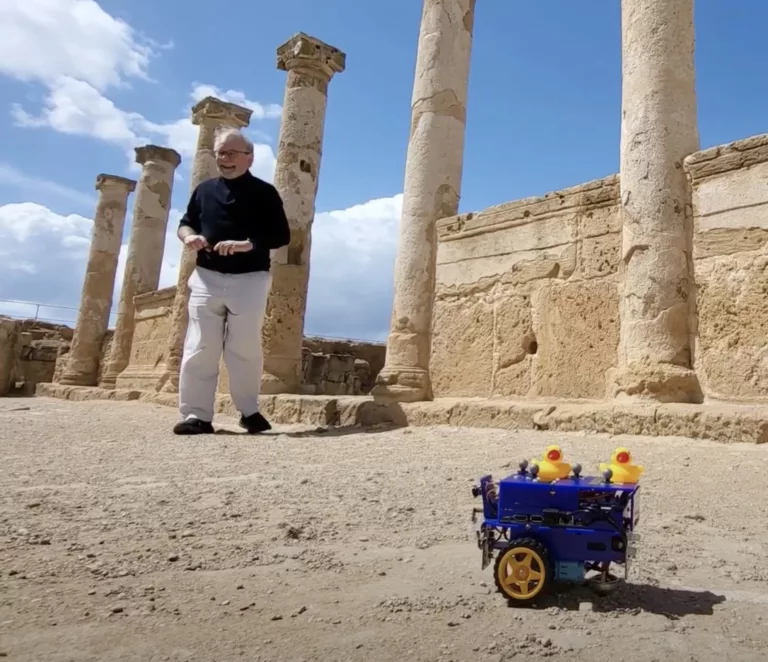
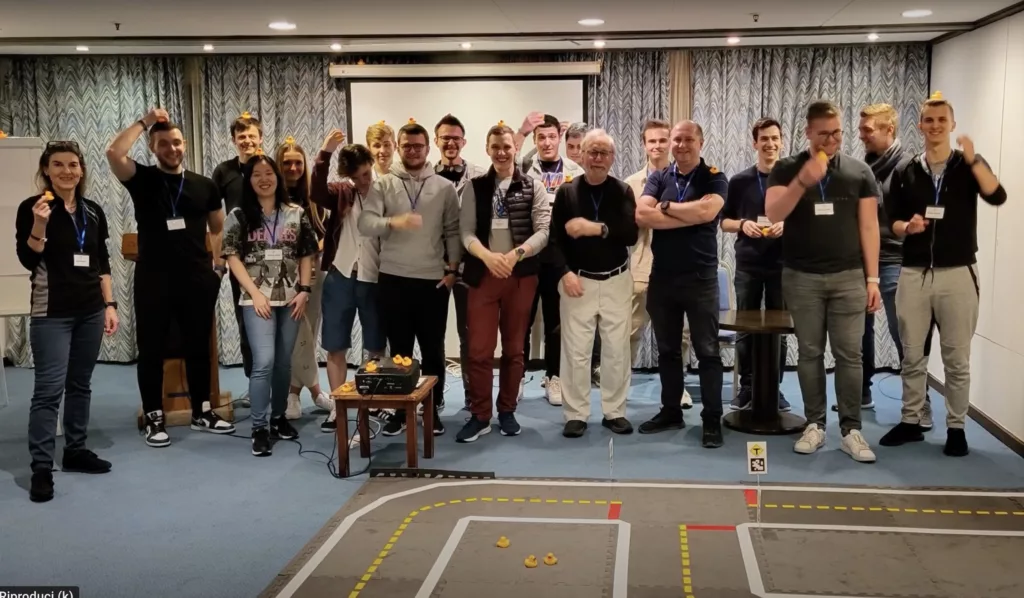
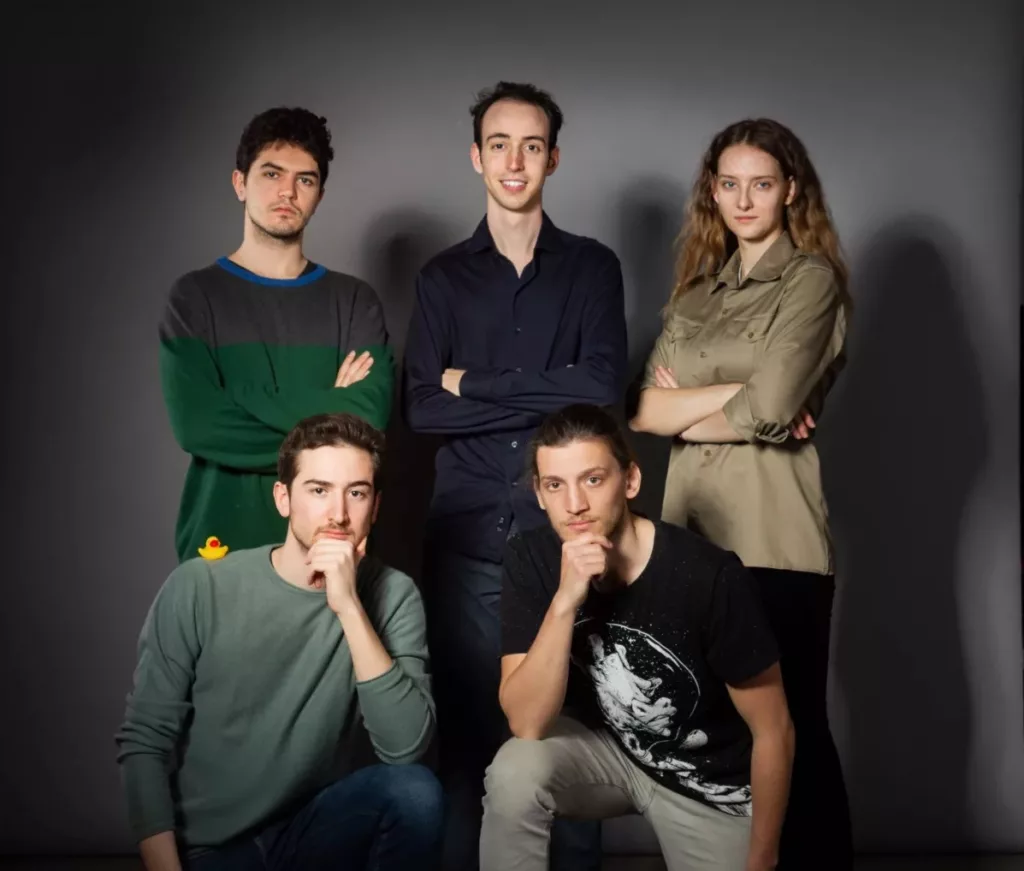
Prof. Bruegge and his colleagues about his experience using Duckietown and the new 4GB Duckiebots.
Munich, April 3rd: Prof. Bruegge (Brügge) studied computer science at the University of Hamburg and Carnegie Mellon University (CMU), where he also earned his doctorate. Appointed as Professor at the Technical University of Munich (TUM) in 1997, and also associate professor at CMU, Prof. Brügge was on the research committee of Deutsch Telekom and the Munich district. He has served on the board of directors of the Center for Digital Technology and Management, and acted as liaison professor for the Max Weber Foundation and the German National Academic Foundation (2000–2017).
Failing successfully, an interview with Prof. Bruegge
Prof. Bruegge and the JASS 2023 summer camp
Prof. Bruegge, Bernd, is an established computer scientist researcher and Professor, having (co)authored hundreds of peer reviewed publications with over 8800 citations at the time of this writing.
In this interview we capture his experience from the summer 2022 edition.
We are thrilled to have this chat with him!
Good morning! Could you introduce yourself?
My name is Bernd Bruegge. I was a Full Professor of Computer Science at the Technical University in Munich, I was at Carnegie Mellon before I joined the Technical University. I was for 20 years at the Computer Science Department at CMU in Pittsburgh, Pennsylvania.
What can you tell us about this JASS school event that took place in Cyprus?
The recent [2023] school was quite an adventure!
My colleague, Prof. Kirill Krinkin, was in St. Petersburg. We had done all the JASS projects with Kirill and support activities by JetBrains in St. Petersburg. And as you know, it’s a total disaster there, there’s nothing left.
So we organized this school in Cyprus with 10 students from Munich and 10 from Cyprus and St. Petersburg. And once there, we built an advanced Duckiebot system, with focus on context sensitivity.
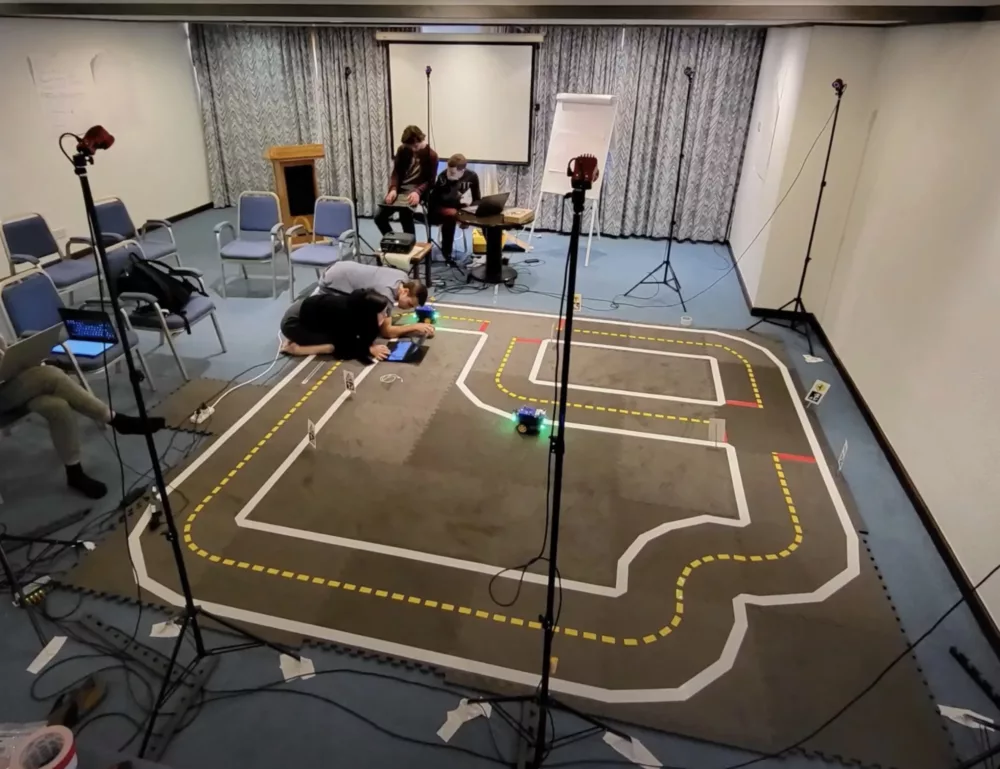
We looked not only at intersections and turns, but we also had times when the Duckiebots would have to slow down, or stop at repair sites where we had traffic lights. There were not only OCR codes, we used Thread and Matter. Are you familiar with Thread and Matter?
I call this a "successful failure". The challenge in using advanced technology in the real world is that when you explore edge cases, unexpected situations may arise that one would not have considered by just simulating the same scenarios.
Is this a new functionality you added to the system?
Yes, this is actually an add-on we made to Duckietown. It’s a new IP standard that allows to save energy much, much more than Bluetooth. It’s actually better by a factor of 10. We added Thread and Matter capabilities to our Duckietown environment.
That's fascinating! When did you first encounter Duckietown?
Well, I first heard of Duckietown a long time ago. As you know, I have been at Carnegie Mellon, which competed with MIT and Stanford. And when Kirill told me he would be a visiting professor at MIT, I asked: “What are you doing there?” And he said, “I’m using Duckietown!”
He was interested in robots and robotic technology and observed that this new technology is actually more like an environment and ecosystem than just a robot.
We then came up with a few ideas: first in St. Petersburg, we used a combination of drones and Duckiebots. Our scenario included two airports and a (duckie!) passenger. The drone had to pick up the duckie from one Duckiebot, and the students, divided into three teams, had to develop their own pickup mechanisms.
Each of them with different approaches. One used magnets, the other one used scoops, and so on. They had to then transport the duckie from airport A to airport B using indoor navigation GPS. There was our first really impressive demo.
Credits: Special thanks to Andreas Jung and Ruth Demmel, and the multimedia team supporting Prof. Bruegge.
Prof. Bruegge, do you feel you achieved your objectives?
I’d say we didn’t fulfill our technical objectives. The main challenge with Duckiebots was the third, omnidirectional, wheel, which had too much attrition. So, for instance, if we came to drive near a church, the idea would be to slow down the speed. But then we discovered it was difficult to control the Duckiebot at low speed, since when it comes down to a crawl, friction may cause it to stop. So operating at low speeds was not a practical possibility.
But I call this a “successful failure”. The challenge in using advanced technology in the real world is that when you explore edge cases, unexpected situations may arise that one would not have considered by just simulating the same scenarios.
I think the Duckiebot is good at lane-following and following traffic rules. When looking at context sensitivity though the challenges are trickier. So, e.g., we have a construction site with two traffic lights, how to coordinate them so to minimize, e.g., traffic? If you have one Duckiebot coming from one side and one coming from the other, then one traffic light should go green, and the other one should be red.
But then we also have the idea that you have one traffic site that consists of multiple repair sites. In that situation the Duckiebots, lining up at the red traffic light, should have a green wave to go through each of the traffic lights until they exit the last traffic light.
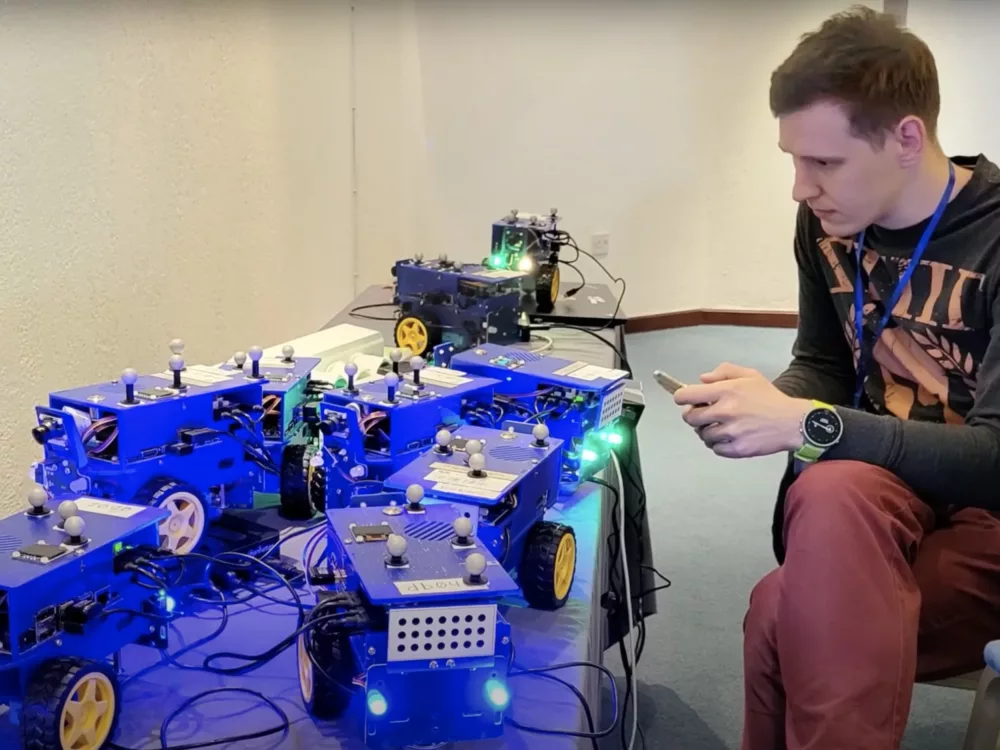
So what we had in mind was coordination, making sure the Duckiebots were talking to each other. We used Python and the Duckiebots with 4GB NVIDIA Jetson Nanos, and this happened during a five-day course.
Is there anything else you would like to add?
We plan to prepare a special room for students from primary schools, to show them the interplay of autonomous driving and context-sensitive or ubiquitous computing.
We would like to use the room in multiple ways. So we would like to have the Duckietown road sections, the tiles, interconnected in such a way that that allows us to switch between topographies basically in no time.
We have not been able to do this yet in an easy way, it’s always a scramble. Even if we use the same layout, the yellow tape is breaking or the white tapes are out of sync, and then we have to repair them.
So it would be great if we managed to keep the set up time for schools, especially for children (10 to 12 years), when doing exhibitions here, to under three minutes.
That's a great suggestion, thanks! Do you think Duckietown can be useful for younger learners too?
Yes, I think Duckietown can be very persuasive with young kids. They’re used to Lego or Fischer products, so when they meet the Duckiebot, that’s their first exposure to robots.
We actually have another project in mind, a series of Summer Schools. I’m a retired professor now, I don’t have to teach so I have time for Summer Schools! One will take place in the Dolomites, where the challenge will be a logistic one taking place in a factory. It will include robots moving packages around a warehouse.
Learn more about Duckietown
Duckietown enables state-of-the-art robotics and AI learning experiences.
It is designed to help teach, learn, and do research: from exploring the fundamentals of computer science and automation to pushing the boundaries of human knowledge.
Giulio Vaccari tells us how he spearheaded Duckietown at the Milan Polytechnic through the AEA student association, to support autonomy research and networking.
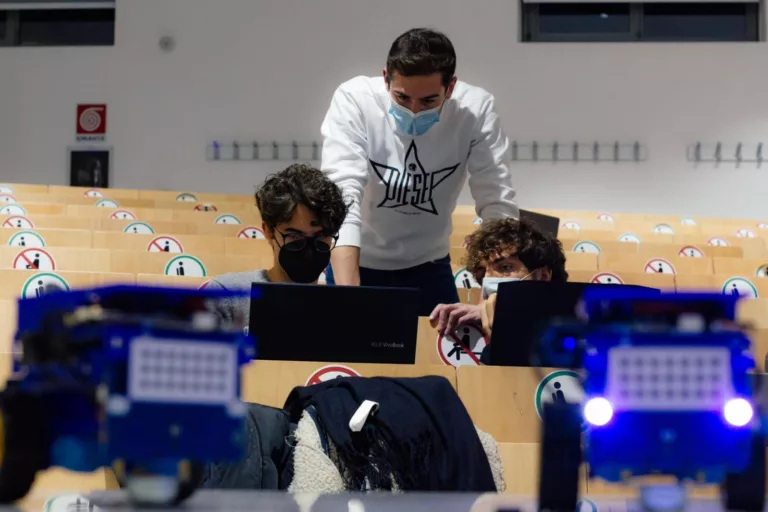
Milan, February 29th: Giulio Vaccari, master student at the time of this interview, tells us how and why he spearheaded the use of Duckietown at the Polytechnic of Milan, one of the most important Italian engineering universities.
Spearheading Autonomy: Giulio Vaccari and the amazing student Automation Engineering Association (AEA)
An interview with Giulio Vaccari from the Polytechnic University of Milan
Hello and welcome Mr. Giulio Vaccari! Could you introduce yourself?
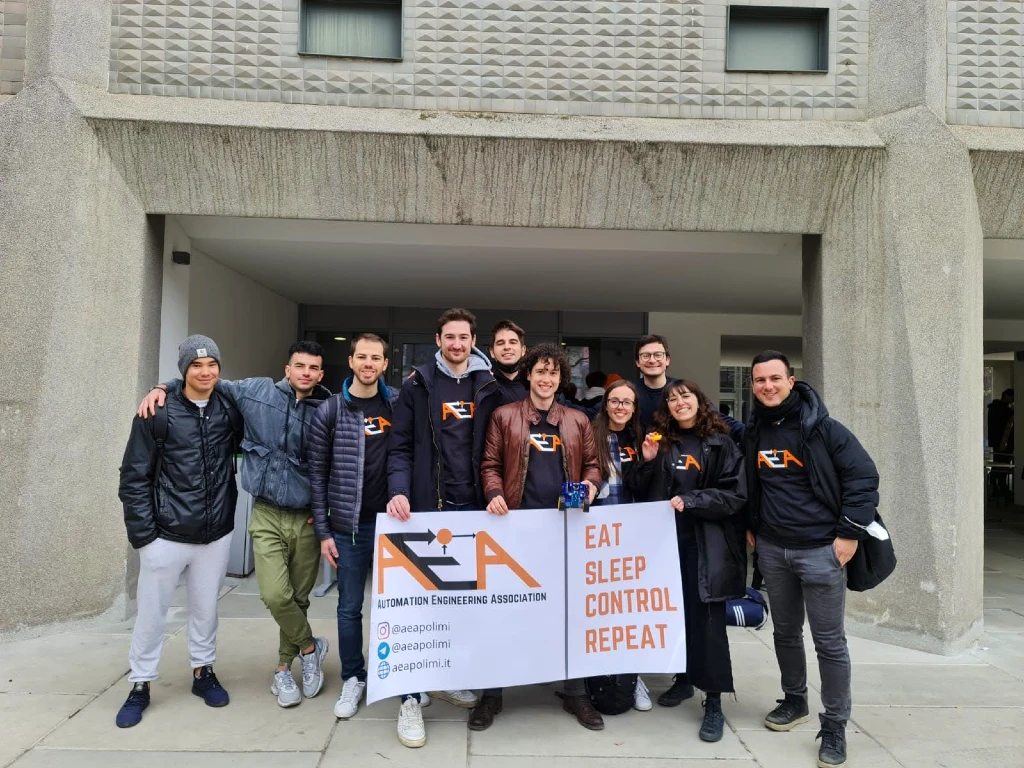
My name is Giulio Vaccari, and I’m a master student at the Politecnico di Milano (“Polimi”). I am studying automation and control engineering and I am right now in the process of finishing my thesis with Duckietown. During my five years here, I founded the student Automation Engineering Association, focused on automation engineering. At the “Polimi” the course of control and automation engineer is not super big, now it’s getting bigger. More and more people are joining, but it’s still pretty small compared to, for example, computer science or other bigger courses. The idea of our association was to help with networking, help to understand what are future possible career paths as automation engineers. That’s why together with some friends we decided to found the association some years back.
Very interesting. How does Duckietown fit in all this?
It all started when I met and talked with Jacopo Tani and Vincenzo Polizzi I believe three years ago.
I had some friends, older friends, at ETH Zurich that introduced us to Duckietown as a possible project for our association, that at the time was still pretty small. We were newborn and we liked the idea of start working with Duckietown right away, because we were looking for a project that we could treat like a competition. It’s easier to get more people to know each other and network, when they have a common goal, as there are common topics to discuss.
I wanted something that would help us develop teamwork skills, something around which to build a strong team. Then this idea evolved a little bit and now we have a very focused and skilled team that works with aim of doing good at the Artificial Intelligence Driving Olympics (AI-DO). We did our first competition in 2021, in December, and it went well. Now we are improving. We are still working on it.
Could you tell us more about your team's experience with the AI-DO competition?
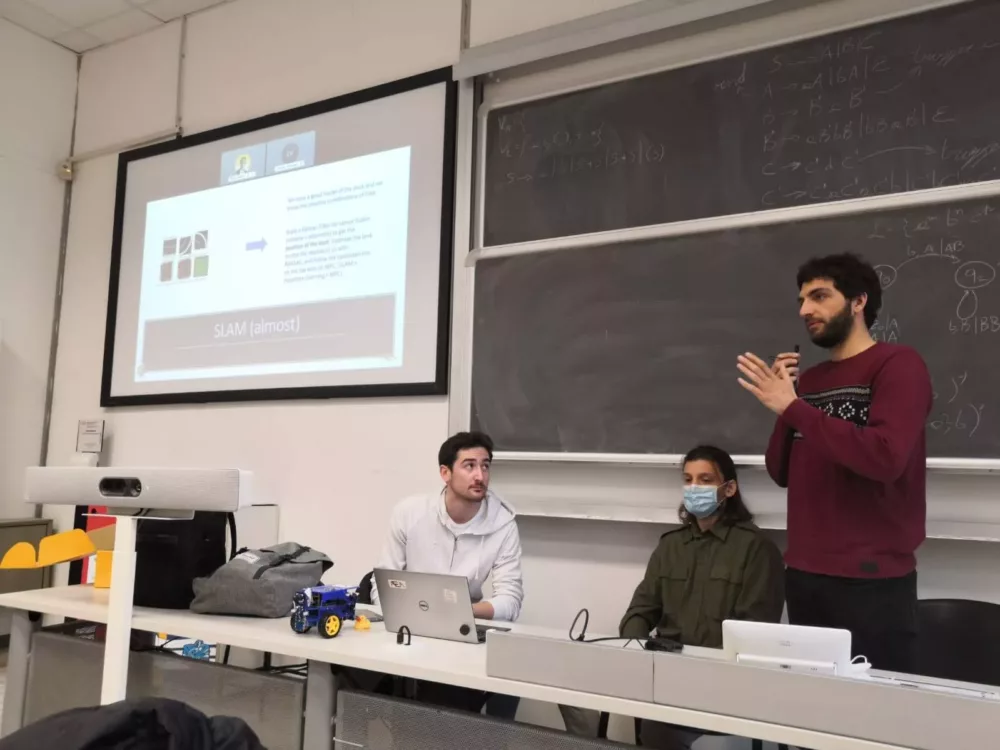
Sure! We ended up being finalist, I’m very proud of that! In the meantime, I talked with some professors to try to get some help to improve what we were doing with Duckietown, to have some suggestions on what we should focus on. I was lucky enough to meet a Professor, now my thesis advisor, who had already heard about Duckietown and liked it. I was very happy that we were able to bring Duckietown to the Politecnico of Milano. Although the AI-DO are over now, I’m still doing related work, so I’m able to help the team do better while working on my thesis. Duckietown is now part of the laboratory for autonomous driving here at PoliMi, and I feel like managing to get Duckietown to be adopted by the Politecnico di Milano is a pretty big thing that I’m still proud of!
And you should be! Do you use Duckietown also in the activities of the association?
When it comes to the association, we are focused on AI. We have a team of around 20 people working on different things. We use Duckietown also to do outreach when we have, for example, “associations days”, which are open days when students from high schools come and visit the University. That’s when we showcase Duckietown to show both what we do as an association but also what a control engineer is supposed to do, because it’s very difficult to explain otherwise.
What do you like about Duckietown? Why do you think it is useful for what you do?
Through Duckietown, it’s very easy to implement ideas in the real world. Usually if you need to build something like that from scratch, it will be super difficult. There are a lot of failure points, while with Duckietown we can just deploy it and it just works. This is super cool. We can also test a lot of different control strategies with very low effort. I mean, just the fact of writing the control algorithm, deploying it and it just works is huge. So this makes things super easy. Duckietown is very friendly and easy to use. It’s not something you often see in robotics, which is instead usually very complicated and intimidating. Yes, very intimidating. And Duckietown is even very friendly looking, and this is definitely a big plus!
Do you think people that are using Duckietown, are satisfied with it?
Yes, we had really positive feedback. I mean, everyone is really happy to work with Duckietown and we had so many people applying that we had to limit the team size because that would’ve made it very difficult to manage all those people. So I would say it had a very positive impact in general on the association. People are generally enthusiastic to just see the robots going around.
There are a lot of failure points in robotics, while with Duckietown we deploy our algorithms and it just works. This is super cool. We can test a lot of different control strategies with very low effort.
Would you suggest it to colleagues or other student associations?
Yes, for sure. But I see that it’s not only our team; also the Professor that I’m working with is very happy to be able to use it, also as a benchmark for different controls. There are other universities that have their very specific tracks to run their robots, while with Duckietown, it’s super easy to test like, the same strategy in different environments, but still with the same basics. This is a very positive thing also for the university.
Thank you very much for taking the time, we appreciated your story very much! Is there anything else you would like to add?
Right now I’m working on a different subject. So I’m using still Duckietown, but not in a city environment, but in a racing environment. My objective is to set up a racing track and have two robots compete against each other. They are still not competing, but we are getting close. It’s very nice that together with the Duckietown team, we are working on the urban environment, using different kind of materials to create these racing environments. I think it’s very cool.
There are also some issues every now and then. Maybe something that is not super easy to find, something that is very in depth, some APIs. If you want to use them, you need to dive deep. There is a support Slack channel though, and it’s super easy to ask for help. This too I believe is very nice and just adds to the positive experience.
Special Giulio Vaccari content!
We found in our archives the video submission of Giulio Vaccari and his team at AEA on the occasion of the 2021 AI Driving Olympics finals. In this fun, short, video team PoliMi explains the rationale and challenges faced in developing an ML-based agent for the 2021 competition!
Learn more about Duckietown
The Duckietown platform enables state-of-the-art robotics and AI learning experiences.
It is designed to help teach, learn, and do research: from exploring the fundamentals of computer science and automation to pushing the boundaries of human knowledge.