


Teaching robot autonomy at The Hague University
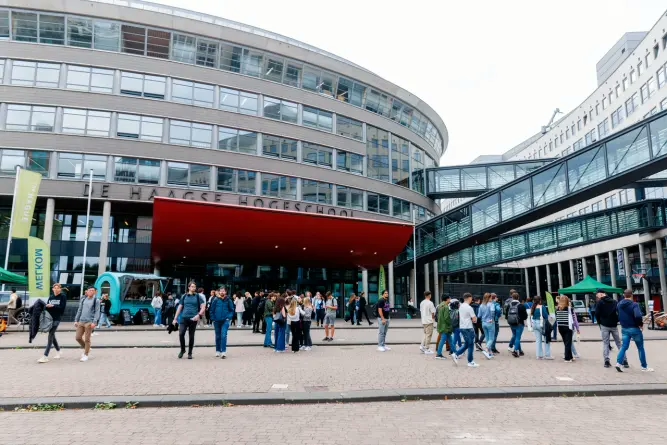
The Hague University of Applied Sciences, The Netherlands, May 2026: Vikram Radhakrishnan is a Lecturer in the Applied Data Science & AI program at The Hague University of Applied Sciences, where he developed a specialization in self-driving vehicles using Duckietown as the primary educational platform.
In this interview, he shares how the course came to life, how students approach robot autonomy and autonomous driving, and what he has learned from introducing hands-on robotics into an applied AI curriculum.
Teaching robot autonomy with Duckietown
Hi, thank you for sharing your time with us! Could you introduce yourself?
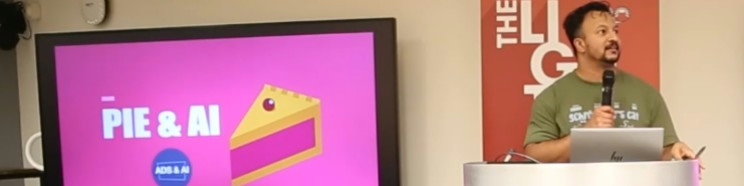
My name is Vikram Radhakrishnan, and I am a Lecturer at The Hague University of Applied Sciences, where I teach in the Applied Data Science & AI program. It’s a relatively new four-year undergraduate program, and this year we’re graduating our first cohort of students.
In the third year, students can choose to specialize either in Generative AI or in Self-Driving Vehicles, which is the specialization I developed.
Could you tell us more about this program?
The course is designed to introduce students to the main building blocks of autonomous driving. We begin with computer vision and image processing, covering topics such as lane following and object detection.
From there we move on to localization techniques, including Simultaneous Localization and Mapping (SLAM), before finishing with navigation, control, and path planning.
The goal is to expose students to the complete autonomous driving pipeline through practical, hands-on exercises.
What kind of projects do students complete during the course?
The course contains three major projects.
The first project focuses on lane following combined with object detection, giving students practical experience with computer vision.
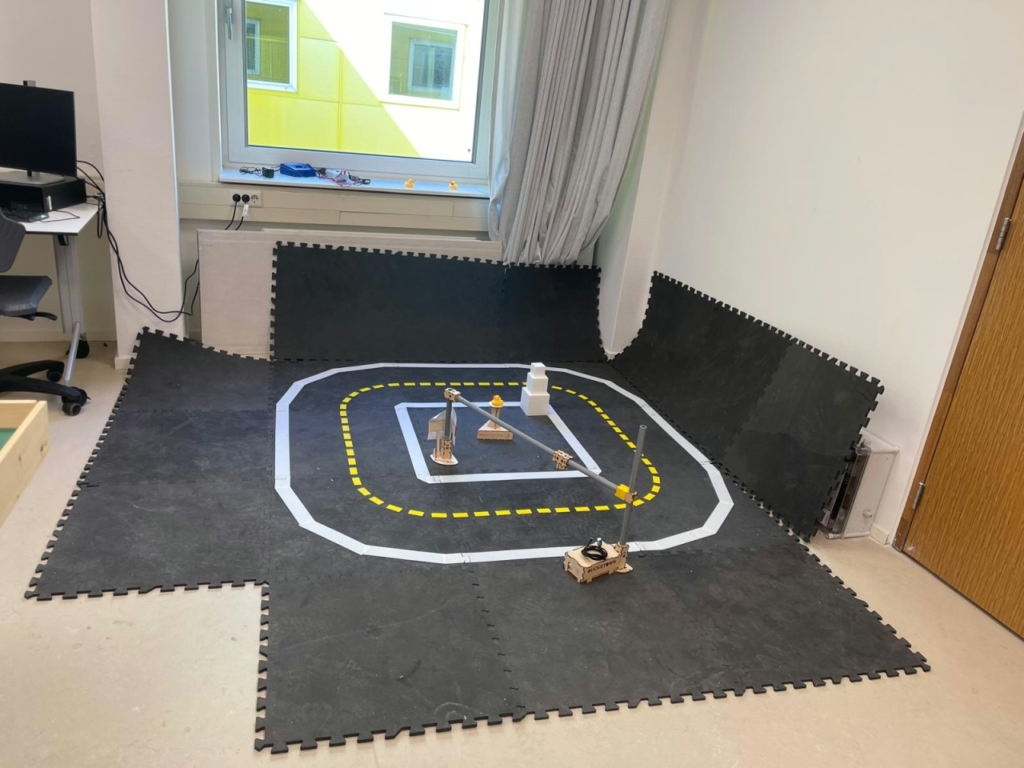
The second project is considerably more advanced. Students learn concepts such as Extended Kalman Filter localization and monocular SLAM, including ORB-SLAM3, before selecting an approach to map their environment while driving through the Duckietown.
The final project combines everything they have learned. Students navigate autonomously from one point to another while simultaneously building a map of the environment.
Throughout the course I ask students to record videos of their work and share them with the class, which has been a great way to document their progress.
Students enjoy working with real robots, the practical nature of the course keeps them engaged because they can immediately see the results of what they implement.
Vikram Radhakrishnan,
Lecturer in applied data science and A.I., The Hague University of Applied Sciences
How are students responding to the course?
They enjoy working with real robots.
The practical nature of the course keeps them engaged because they can immediately see the results of what they implement.
The biggest challenge isn’t motivation but complexity. Some topics, particularly localization and SLAM, involve mathematics that can be demanding for students at a university of applied sciences.
I usually focus on giving them a strong conceptual understanding while allowing them to work with existing implementations rather than diving deeply into every mathematical derivation.
Why did you choose Duckietown?
Before developing the course, I looked for a platform that could provide both the hardware and the software needed to teach autonomous driving effectively.
I saw that Duckietown was already being used by multiple universities and research institutes, and what immediately stood out was the amount of educational material that was already available. Having an integrated platform with existing learning experiences made it a very attractive choice.
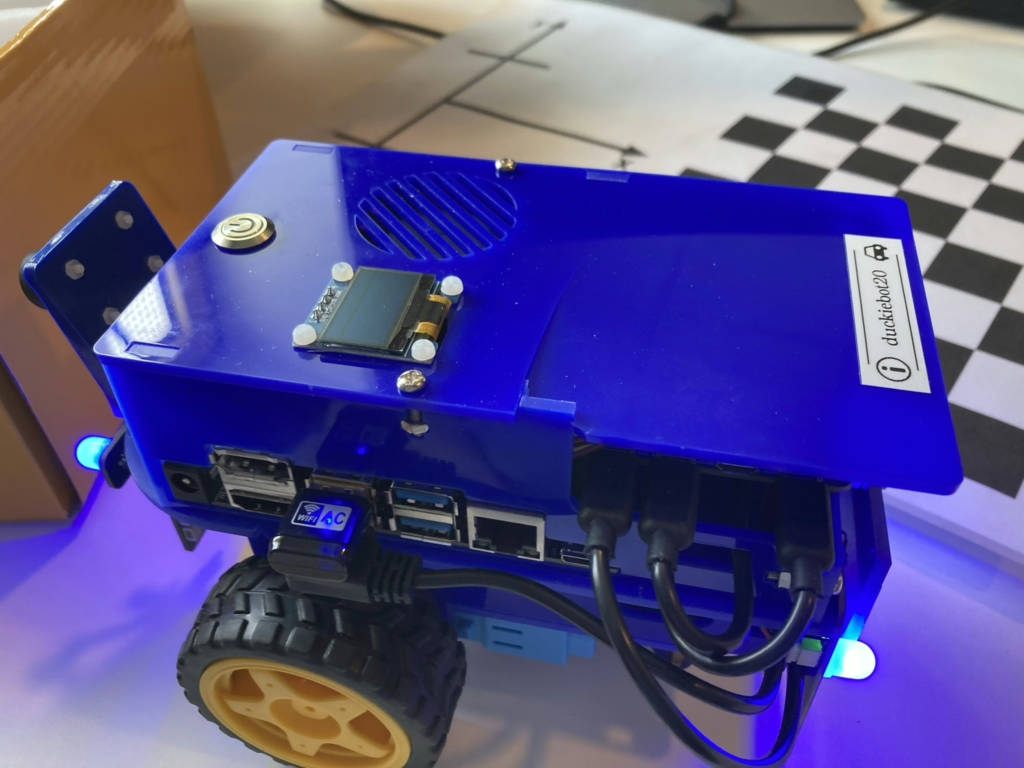
Initially we purchased three Duckiebots because this was an elective course and we didn’t know how many students would enroll.
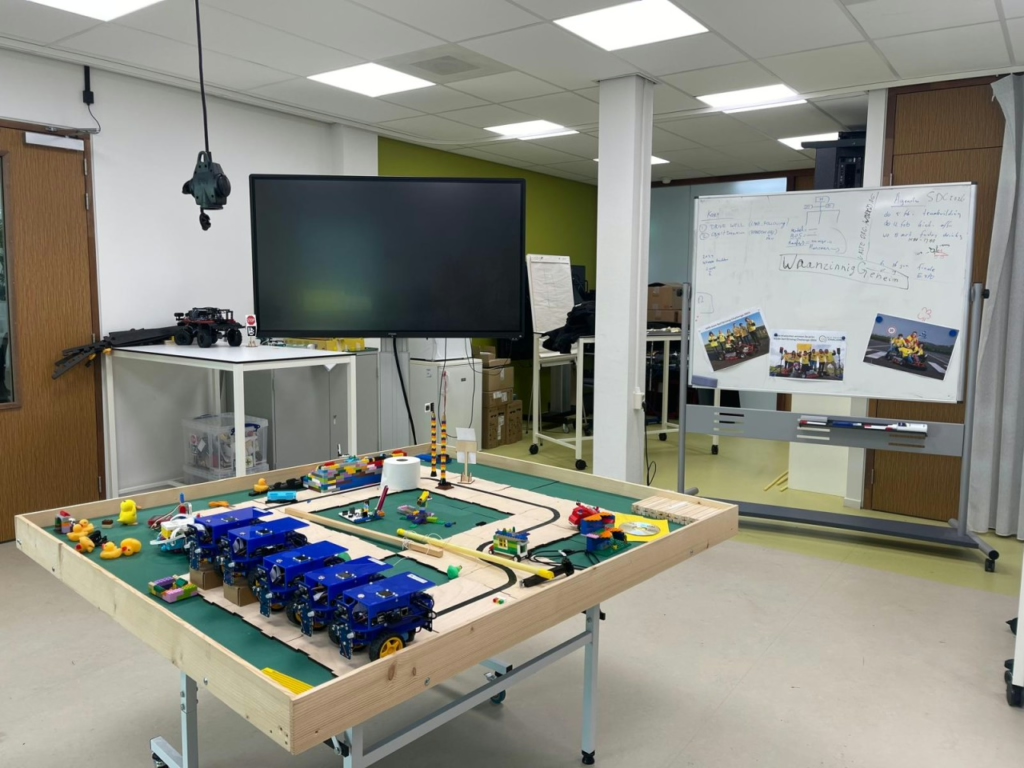
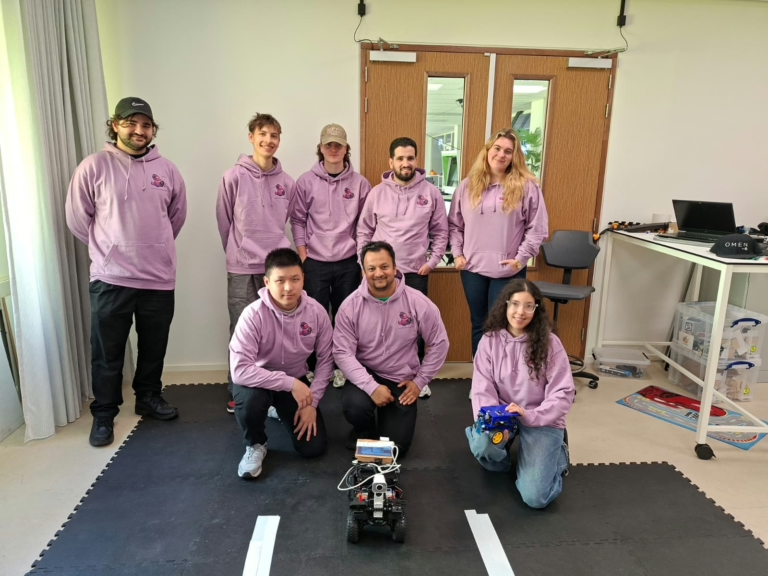
Eventually eighteen students signed up, so we rented three additional robots. Today we have six purchased Duckiebots together with three rental units, which allows students to work directly with the hardware.
You were among the first instructors to use the Duckiebot rental program. How was your experience?
Overall it has been a positive experience.
We had some delays at the beginning due to shipping and customs, so it took a little longer before the rental robots reached us. Once they arrived, though, having additional robots made a significant difference because all eighteen students needed access to physical hardware.
Looking ahead, we would probably purchase additional robots instead of renting simply because it simplifies logistics.
What do you see as the strengths of Duckietown and what were the challenges you encountered?
The biggest advantage is the complete ecosystem.
The hardware, software stack, documentation and educational materials are all available, allowing instructors to build a course without starting from scratch.
For example, the existing lane-following implementation provides an excellent foundation that students can immediately experiment with and extend.
Regarding the challenges, Duckietown provides excellent learning experiences that explain individual components, whether that is ROS, object detection or another topic. However, understanding how all those individual pieces fit together into one complete autonomous system takes time.
Even for instructors, there is a significant learning curve before the overall architecture becomes clear.
I also found that some tutorials and template repositories differ slightly in their structure, which can be confusing for students when they begin developing their own ROS nodes.
Also, most students use Windows laptops, and we initially tried to use development containers, but we weren’t able to get that workflow running reliably. In the end, we asked students to install Linux as a dual-boot.
Making the development environment easier to access across operating systems would certainly lower the barrier for new users.
Your students also participate in the Self-Driving Challenge. Is that part of the course?
The competition is actually separate from the course itself.
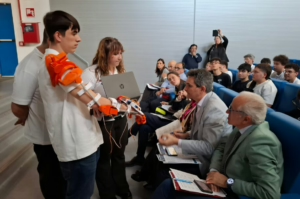
Our university has participated in the Self-Driving Challenge for several years, and this year the event has become international, with teams from multiple countries taking part.
I think there’s a great opportunity for closer collaboration between the competition, universities teaching autonomous driving, and Duckietown itself.
We’re all working toward the same objective of helping students learn robot autonomy through hands-on experience.
Finally, would you recommend Duckietown to other instructors?
Absolutely.
If you’re looking for a practical platform to teach autonomous driving, Duckietown provides a complete educational ecosystem. Students don’t just learn isolated algorithms; they see how perception, localization, planning and control all come together on a real autonomous robot.
That combination of theory and hands-on implementation is what makes the learning experience so valuable.
Learn more about Duckietown
Duckietown enables state-of-the-art robotics and AI learning experiences.
It is designed to help teach, learn, and do research: from exploring the fundamentals of computer science and automation to pushing the boundaries of human knowledge.
Tell us your story
Are you an instructor, learner, researcher or professional with a Duckietown story to tell?
Reach out to us!